We may earn a commission when you buy through links on this page, at no extra cost to you. How this works.
Many home coffee brewers buy quality beans and follow careful grind and water-ratio guidelines, yet still experience flat or bitter drip coffee that doesn't match what they taste at specialty cafés. Water temperature is one of the most overlooked variables in home brewing: too hot and the coffee tastes harsh and over-extracted, too cool and it comes out weak and sour. A temperature control kettle gives you precise control over brew water, typically holding within one or two degrees of your target, but it also adds cost and counter space compared to a standard stovetop or electric kettle.
This guide examines whether that precision translates into noticeably better drip coffee for your situation. We'll compare how much temperature variation affects flavor, which brewing methods benefit most from tight control, what features actually matter in a temperature kettle, and when a simpler solution may be sufficient. The goal is to help you decide whether the investment makes sense for your beans, your brewing routine, and your taste expectations.
If you already own good beans and a reliable grinder, understanding water temperature may be the last step toward consistently excellent drip coffee at home.
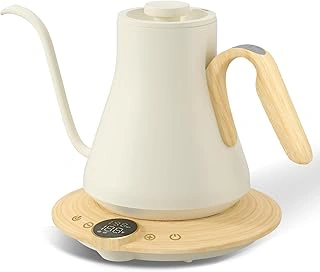
Cocinare Barista Collection Gooseneck Electric Kettle with ±1℉ Precise Temperature Control, 0.9L
The Cocinare Barista Collection Gooseneck Electric Kettle delivers ±1℉ precise temperature control, making it a strong choice for drip coffee drinkers who want exact brewing temperatures. This 0.9-liter kettle is sized for the listed size brewing sessions, and the gooseneck spout design allows for controlled, steady pours whether you're using a standard drip machine or experimenting with pour-over methods.
At $79.99, it sits in the mid-range price tier for temperature-controlled kettles. The 1-degree precision gives you the ability to fine-tune water temperature to match specific coffee roasts or brewing recommendations - dark roasts typically prefer temperatures around multiple℉, while lighter roasts often benefit from water closer to multiple℉. If you've been using boiling water or guessing at temperature with a standard kettle, this level of control can noticeably improve flavor extraction and reduce bitterness or sourness caused by temperature mismatch.
The 0.9-liter capacity is practical for single-serve or small-batch brewing but may feel limiting if you regularly make coffee for multiple people. The gooseneck spout adds versatility, making this kettle useful beyond drip coffee if you decide to explore manual brewing methods. The product holds a 4.4/5 rating, reflecting solid performance in real-world use. If exact temperature control matters to your coffee routine and you brew in smaller quantities, this kettle offers a meaningful upgrade without reaching premium price points.
- ✅ ±1℉ precise temperature control for exact brewing temperatures
- ✅ 0.9L capacity ideal for 1-2 cup brewing sessions
- ✅ Gooseneck spout design supports controlled, steady pours
- ✅ $79.99 mid-range price point
- ✅ 4.4/5 customer rating
- ⚠️ 0.9L capacity may be small for multiple servings
- ⚠️ Mid-range investment may not suit occasional coffee drinkers
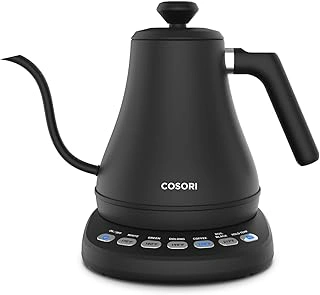
COSORI Electric Gooseneck Pour Over Kettle with 5 Temperature Control Presets
The COSORI Electric Gooseneck Pour Over Kettle offers five temperature presets that cover typical drip coffee brewing ranges without requiring manual degree adjustments. Priced at $69.99 with a 4.7/5 rating, it delivers reliable temperature control for users who prefer a simplified approach to precision brewing.
The preset system means you can select a common brewing temperature - usually including options for delicate teas and full-bodied coffee - by pressing a button rather than scrolling through individual degrees. This removes the guesswork for drip coffee users who want consistency but don't want to memorize exact temperature targets. The gooseneck spout provides the controlled pour rate that benefits manual drip methods like Chemex or V60, where water placement matters.
At this price point, the COSORI balances accessibility with practical temperature precision. The 4.7/5 rating suggests solid build quality and day-to-day reliability, which matters when a kettle becomes part of a daily routine. The tradeoff is less granular control compared to models that allow one-degree increments; if you experiment frequently with narrow temperature windows, you may find the preset steps limiting. For most drip coffee brewing, however, the five presets align well with recommended temperature zones, making it a practical choice for users who value simplicity and repeatability over fine-tuning.
The set-it-and-forget-it design works especially well in kitchens where multiple people brew coffee or where speed and ease reduce morning friction. If your drip coffee routine benefits from stable, repeatable temperatures without manual calibration, the COSORI's preset approach and strong user rating make it a dependable option at a competitive price.
- ✅ Five temperature presets simplify common drip coffee brewing needs
- ✅ Gooseneck spout supports controlled, precise pouring
- ✅ Strong 4.7/5 rating indicates reliable performance
- ✅ Competitive $69.99 price for preset temperature control
- ⚠️ Preset steps may limit experimentation with narrow temperature ranges
- ⚠️ Less granular control than one-degree increment models
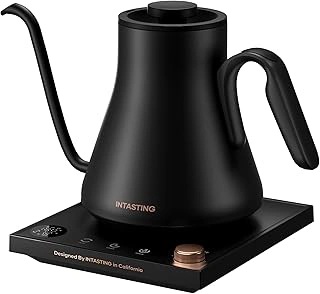
INTASTING Gooseneck Electric Kettle with ±1℉ Precise Temperature Control, 0.9L
The INTASTING Gooseneck Electric Kettle with ±1℉ Precise Temperature Control offers an accessible entry point for drip coffee drinkers curious about temperature precision without the higher price tag. At $69.99, it delivers the same ±1°F accuracy found in more expensive models, giving you the control needed to brew lighter roasts at multiple°F or darker blends at multiple°F with consistency. The 0.9-liter capacity handles three to four cups per boil, which suits most single-user or small-household drip routines.
With a 4.6 out of 5 rating, this kettle presents a practical option for users still testing whether temperature control makes a noticeable difference in their daily coffee. The gooseneck spout supports steady, controlled pouring whether you're using a flat-bottom dripper or a cone filter. If you're moving from a standard kettle and want to explore how precise water temperature affects extraction and flavor balance, this model provides the essential feature set without optional extras that add cost.
The ±1°F precision means you can repeat the same brew temperature day after day, which helps isolate other variables like grind size or bloom time when you're refining your drip technique. The tradeoff here is simplicity: you get reliable temperature control in a straightforward package, but features like programmable presets or hold timers aren't part of the design. For many drip coffee drinkers, especially those new to temperature-controlled brewing, that focused simplicity is exactly what makes the investment worthwhile.
- ✅ ±1°F precision at a lower price point ($69.99)
- ✅ 0.9L capacity suitable for three to four cups
- ✅ Gooseneck spout supports controlled, steady pouring
- ✅ Straightforward design focused on core temperature control
- ⚠️ No programmable presets or advanced timer features
- ⚠️ Limited capacity may require multiple boils for larger batches
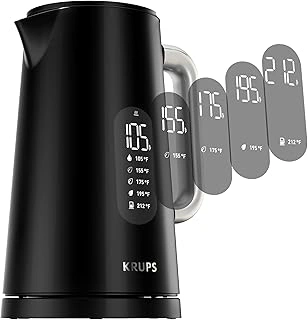
KRUPS Smart Temp Electric Kettle with 1.7L Capacity, 5 Precise Temperature Settings
If you brew multiple cups or serve coffee to a group, the KRUPS Smart Temp Electric Kettle offers the listed size of capacity - enough for eight to ten cups in a single batch. Five preset temperature settings cover the ideal drip coffee range, letting you dial in water temperature without guessing or using a separate thermometer. At $67.20, the price per liter is competitive for a programmable electric kettle with this level of control.
The 1.7L reservoir works well for automatic drip machines and large French presses, reducing the need for refills during morning routines or when entertaining. The preset buttons simplify temperature selection, and the keep-warm function holds your chosen setting for up to thirty minutes. The spout is wider and shorter than gooseneck designs, so this kettle is less suited to precise pour-over technique but pairs naturally with automatic drip brewers where you pour into a reservoir rather than directly over grounds.
Families, offices, or anyone brewing in volume will appreciate the combination of capacity, temperature flexibility, and accessible price. If you prioritize a single-cup ritual or manual pour control, a smaller gooseneck model may fit your workflow better. For batch brewing with dependable temperature accuracy, this kettle delivers practical value without unnecessary complexity.
- ✅ 1.7L capacity brews eight to ten cups per fill
- ✅ Five preset temperatures cover drip coffee range
- ✅ $67.20 price offers strong value for capacity
- ✅ Keep-warm function holds temperature for thirty minutes
- ⚠️ Standard spout less precise for manual pour-over
- ⚠️ Larger footprint than single-serve kettles
Who This Is For (and Who Can Skip It)
Temperature control kettles deliver the most value for manual pour-over users who need consistent precision. If you brew with a V60, Chemex, Kalita Wave, or similar dripper, controlling water temperature within a few degrees lets you highlight the flavors already present in your beans - especially lighter roasts that depend on precise extraction to show fruit, floral, or tea-like notes. Manual brewing also means you control the pour rate and pattern, so adding temperature control completes the picture.
Light roast drinkers benefit more than those who prefer dark roasts. Light roasts extract best between 195 and 205°F; water that's too hot pulls bitterness, while cooler water leaves flavors muted. Dark roasts are more forgiving and often taste balanced across a wider temperature range, so the precision matters less.
People using automatic drip machines may find value if their brewer runs consistently too hot or too cold. If your current machine brews above 210°F or below 190°F - temperatures you can estimate with an instant-read thermometer placed in the carafe immediately after brewing - a temperature kettle lets you pre-heat or cool water to the ideal range before it enters the brewer. That said, this workaround adds steps and may not suit every machine design.
You can skip the investment if you use a quality automatic drip machine that already brews in the 195 - 205°F range, such as SCA-certified models. Standard drip users who prioritize convenience over control, or those who drink only dark roasts and are satisfied with their current flavor, will see minimal return. If you're happy with your coffee as-is and don't plan to experiment with manual methods or lighter beans, a temperature control kettle won't change your routine in a meaningful way.
What Temperature Control Actually Does for Drip Coffee
Water temperature directly controls how much flavor you extract from coffee grounds during brewing. When water touches ground coffee, it pulls out soluble compounds - acids, sugars, and oils - at different rates depending on how hot it is. Too cold, and you extract only the brightest, sourest notes while leaving behind sweetness and body. Too hot, and you draw out harsh, bitter compounds that mask the coffee's character.
Most drip coffee achieves balanced extraction in the 195 - 205°F range. Within that window, water is hot enough to dissolve desirable flavors but not so hot that it strips out astringency. A temperature control kettle lets you dial in a precise target and hold it there, so every brew starts from the same baseline instead of guessing whether your standard kettle has cooled from boiling or is still climbing.
Light roasts benefit from the higher end of that range - around 202 - 205°F - because their denser structure and higher acidity need more heat to unlock sweetness and complexity. Dark roasts, already broken down by longer roasting, extract faster and taste smoother at 195 - 200°F, where lower temperatures prevent over-extraction and bitterness. A fixed-temperature kettle forces you to brew everything the same way; a controllable one adapts to the coffee in front of you.
The difference shows up as consistency. When you remove temperature as a variable, it's easier to isolate other factors - grind size, brew time, coffee-to-water ratio - and refine your process. You stop chasing why yesterday's cup tasted bright and today's tastes flat, because the water hitting the grounds is always the degree you chose.
Features That Matter (and Gimmicks You Can Ignore)
A temperature control kettle offers the most value when it combines precise adjustment, reliable hold function, and a spout design that matches how you brew. For drip coffee, ±1°F precision matters less than the ability to dial in and maintain a target temperature; many quality models offer 1-degree increments, but jumping between five preset temperatures works perfectly well if those presets span 195°F to 205°F. A hold or keep-warm function becomes essential when you brew multiple cups or want consistent temperature without reheating between batches.
Gooseneck spouts deliver exceptional pour control for manual pour-over but add little benefit if you only use an automatic drip machine. A standard spout pours faster and works fine when you're filling a reservoir rather than controlling flow rate over grounds. Capacity should match your typical brew volume: a 0.5-liter kettle suits single servings and pour-over cones, while 1-liter or larger models better serve households brewing full carafes or back-to-back cups.
Some features inflate price without improving drip coffee results. Smartphone app control, Bluetooth connectivity, and programmable schedules sound convenient but rarely justify the cost when a simple dial and hold button accomplish the same brewing outcome. Backlit displays and premium finishes make the kettle nicer to look at, yet they don't change water temperature or flavor. Focus on accurate temperature range, a clear display, and a hold function that lasts at least 30 minutes; those three attributes deliver better coffee without paying for features you won't use.
Common Mistakes to Avoid
Buying a temperature control kettle without matching it to your actual brewing method often wastes money and creates frustration. If you already own an automatic drip machine with built-in heating and temperature management, adding a separate temperature kettle adds no value - your machine is already controlling the water contact. Many buyers also choose gooseneck models designed for pour-over when they plan to use the kettle only with automatic drip brewers, paying extra for a spout shape they won't use.
Temperature alone won't fix coffee that tastes flat or sour if your beans are stale or your grind is inconsistent. A kettle set to 200°F can't rescue old, poorly stored coffee or compensate for a blade grinder that produces uneven particle sizes. Focus on fresh beans and a consistent grind before expecting temperature precision to transform your cup.
Ignoring the hold function is another common oversight. If you brew manually or in stages - such as blooming grounds before the main pour - a kettle that reaches target temperature but doesn't maintain it will cool several degrees by the time you finish, especially in a cool kitchen. Check reviews that mention temperature stability over five or ten minutes, not just the initial heat-up.
Choosing a kettle based on the lowest price without verifying accuracy can backfire. Budget models sometimes display a target temperature on the screen but deliver water several degrees cooler at the spout, a gap that review testing and user reports often reveal. Read third-party accuracy feedback, not just marketing claims, to confirm the kettle holds its stated temperature where it matters.
Finally, don't assume every temperature kettle works well for drip coffee. Some models heat quickly but lack the capacity or spout control needed for manual drip methods, while others focus on tea presets that may not align with coffee's narrower optimal range. Match the kettle's feature set and capacity to your specific drip routine, whether that's filling a large automatic reservoir or controlled pouring over a single-cup dripper.
How to Test If It's Making a Difference
Brew one batch of coffee using your current method, then brew a second batch of the same beans - ground identically - with water held at 200°F throughout the brewing window. Taste both cups side by side, comparing body, brightness, and finish to identify differences your palate can actually detect.
Look for reduced bitterness or astringency in the controlled-temperature cup, clearer fruit or floral notes if your beans are lighter roasted, and a cleaner, more balanced finish overall. If your beans are dark or over-roasted, temperature precision may highlight roast defects rather than improve the cup.
Set realistic expectations: if your grind consistency, coffee-to-water ratio, and bean freshness are already dialed in, the improvement will be noticeable but not transformative. Temperature control removes one variable, but it cannot compensate for stale beans, uneven extraction, or an inaccurate grind size.
Run the test twice on different days to account for taste variation, and keep notes on what you observe. If you detect clearer flavor separation and reduced harshness consistently, the kettle is delivering measurable value for your setup.
Final Takeaway: When the Investment Pays Off
A temperature control kettle is worth the investment if you regularly brew manual pour-over coffee, prefer light roast beans that need precise heat to extract delicate flavors, or if your current drip setup consistently runs too hot or produces bitter, over-extracted coffee. The ability to dial in and hold a specific temperature between 195°F and 205°F makes a noticeable difference in flavor clarity and consistency when you're working with fresh beans and the right grind size.
If you already own a quality automatic drip coffee maker that maintains proper brewing temperature, or if convenience and speed matter more to you than dialing in extraction variables, a temperature control kettle may not deliver enough benefit to justify the cost. The same goes for casual coffee drinkers who aren't experimenting with roast profiles or brew methods - standard electric kettles or stovetop options will get water hot enough without the added expense.
Better coffee comes from the combination of fresh, properly stored beans, a consistent grind matched to your brew method, and water at the right temperature throughout extraction. No single piece of equipment will fix stale coffee or an inconsistent grind, but a temperature control kettle removes one major variable and gives you repeatable results when the rest of your process is dialed in. Focus on the fundamentals first, then add precision tools where they solve a real problem in your routine.
Choosing the Right Temperature Kettle for Your Setup
- Match spout type to your brewing method: gooseneck for pour-over, standard OK for automatic drip
- Decide between preset temps (5-6 settings) or full digital control (1-degree precision)
- Check if hold function matters - essential for multiple cups or slow pour-over
- Consider capacity: 0.9L for 1-2 cups, 1.5-1.7L for larger batches or families
- Verify your drip machine doesn't already regulate temperature well (check manual or test)
- Budget $60-$80 for reliable models with core features