We may earn a commission when you buy through links on this page, at no extra cost to you. How this works.
A coffee grinder with a built-in scale sounds like the perfect solution: one less device on your counter, one less thing to calibrate, and the promise of a streamlined workflow from whole bean to brewed cup. For many home baristas, the appeal is immediate - why juggle two pieces of equipment when one can do both?
But integration comes with tradeoffs that aren't always obvious until you've lived with the tool for a few weeks. A built-in scale means the weighing mechanism is permanently married to the grinding mechanism, and that changes how you maintain the device, how you troubleshoot drift in accuracy, and how you replace a component when it wears out or fails. It also affects your flexibility: you can't swap in a more sensitive scale for light roasts or a larger platform for batch grinding without replacing the entire grinder.
This guide walks through the practical considerations that matter most when evaluating grinders with integrated scales - accuracy and calibration, repairability and component lifespan, workflow fit, and the alternatives that might suit your needs better. The goal isn't to steer you toward or away from built-in scales, but to help you decide whether the convenience aligns with how you actually make coffee, how long you plan to keep the grinder, and what you'll do when something needs adjustment or repair.
If you've been drawn to the idea of a single device but aren't sure whether the integration will simplify your routine or create new friction points, the sections ahead will give you a clearer picture of what to expect.
Who This Setup Is Really For
A coffee grinder with a built-in scale solves a specific problem: you want timed, weight-based dosing without managing two separate devices. But this combination appeals to a narrower audience than marketing might suggest.
This setup works best if you have严重 limited counter space and cannot comfortably fit both a grinder and a separate gram scale. In a small apartment kitchen, dorm room, or office kitchenette, eliminating one device can make the difference between a functional coffee station and clutter.
It also suits someone who values a streamlined, single-step workflow and doesn't plan to experiment much with grind size, dose, or brew method. If you make the same coffee the same way every morning, the built-in scale reduces the number of decisions and touch points.
However, if you already own a capable grinder or a reliable scale, the integrated model is usually a lateral move rather than an upgrade. You're trading modularity and repairability for convenience. When the scale sensor drifts or the grinder burrs wear out, you may need to replace or service the entire unit instead of swapping one component.
This is not the right choice if you want the flexibility to upgrade your grinder independently, use the scale for pour-over or espresso dosing separately, or troubleshoot and repair components on your own timeline. It's a niche solution that works well within clear boundaries, not a universal improvement over separate tools.
What Matters Most: Precision, Repairability, and Workflow
When evaluating a coffee grinder with a built-in scale, three factors matter more than marketing features: precision, repairability, and workflow fit. Each one involves real tradeoffs that affect your daily brewing and long-term ownership.
Precision is where many integrated designs compromise. Standalone coffee scales typically offer 0.1-gram resolution and fast response times because that's their only job. Built-in scales often use lower-cost load cells with 0.5-gram or 1-gram resolution, and they may struggle with consistent accuracy when the motor vibrates during grinding. If you're weighing beans before grinding and dose after, that cumulative error can push you outside your target range, especially for single-origin espresso or pour-over recipes that demand tight tolerances. The scale's placement - under the burrs or beneath the catch cup - also matters. Designs that weigh the entire grinder body can pick up counter vibration or drift from ambient temperature changes, while those that weigh only the output container may be more stable but harder to zero reliably.
Repairability is the hidden cost of integration. When the scale sensor fails - whether from moisture, static, or electronic wear - you often can't replace just that component. Some manufacturers require you to send the entire grinder in for service, and repair costs can approach half the original purchase price. If the grinder's burrs wear out or the motor fails, you're left with a non-functional scale you can't use independently. Standalone grinders and scales each have longer useful lives because they can be serviced or replaced separately. This modularity also means you can upgrade one component without discarding the other, a significant advantage as your brewing skills and preferences evolve.
Workflow is where the promise of convenience meets real-world friction. A built-in scale can streamline your process if you always grind the same amount for the same brew method - measure, grind, done. But flexibility suffers. Switching between espresso and pour-over often means recalibrating or working around the fixed scale position. If you like to weigh beans in the hopper, grind, then weigh the output to check retention, the integrated design forces you into a single measurement point. Dialing in becomes harder when you can't separately weigh what goes in and what comes out. And if you brew multiple methods in one session, you'll likely reach for a separate scale anyway, making the built-in feature redundant rather than helpful.
Understanding these tradeoffs helps you decide whether integration truly simplifies your routine or just locks you into a less adaptable, harder-to-maintain system. The right choice depends on how you brew, how often you change variables, and whether you value long-term serviceability over short-term convenience.
Common Mistakes to Avoid
Even experienced coffee enthusiasts make predictable mistakes when shopping for grinders with built-in scales. Understanding these pitfalls helps you evaluate whether integration truly serves your workflow - or creates new problems.
Assuming integration always saves counter space. Many all-in-one grinders have larger footprints than a compact grinder placed beside a slim scale. Measure your available counter real estate and compare actual dimensions, not marketing promises. If you brew multiple methods - pour over, espresso, French press - you may need the scale free for other tasks while the grinder sits idle, making modularity more space-efficient in practice.
Ignoring scale accuracy specifications. Not all built-in scales offer the 0.1-gram precision serious brewing demands. Budget models sometimes round to the nearest gram, which matters when dosing 15 - 18 grams for espresso. Check the resolution spec, not just the presence of a scale. A separate quality scale often delivers tighter tolerances than an integrated budget option.
Overlooking single-point-of-failure risk. When the scale component fails - whether from spilled liquid, electrical fault, or calibration drift - the entire grinder may need service or replacement. Modular setups let you replace one component without losing both. Ask whether the manufacturer sells replacement scale modules and what the warranty covers. If you can't get a clear answer, that's a red flag.
Not considering workflow friction across brew methods. If you regularly switch between espresso, drip, and cold brew, you'll likely need different grind settings and dose weights. An integrated scale may slow you down if you can't pre-weigh beans separately or if the display is hard to read while adjusting grind size. Test whether the interface lets you change targets quickly, or whether you'll spend more time navigating menus than you'd spend using two simple devices.
Buying based on convenience rather than actual precision needs. Integration feels modern, but your brewing method dictates whether 0.1-gram accuracy matters. French press and drip tolerate wider dose windows; espresso does not. If you're primarily a drip brewer, a grinder with whole-gram scale resolution may suffice - but then a $15 separate scale would too, without locking you into a single ecosystem.
The smartest approach: define your precision requirements, measure your counter space honestly, and consider how often you'll need the scale and grinder operating independently. Integration works beautifully for single-method routines with ample counter room and when both components match your quality threshold. For everyone else, flexibility often beats convenience.
The Modular Alternative: Grinder + Scale Done Right
For most home coffee brewing setups, pairing a quality grinder with a separate precision scale offers more flexibility and better long-term value than an integrated unit. This modular approach has become the pragmatic default among experienced brewers for several concrete reasons.
When your grinder and scale are independent, you can upgrade or replace one without losing the other. If your grinder motor fails after three years, you keep your scale. If you want to move from a flat burr to a conical burr grinder, your scale travels with you. This adaptability matters over the multi-year lifespan of quality coffee equipment.
Separate scales typically deliver tighter precision. Dedicated gram scales from reputable manufacturers often resolve to 0.1 grams with faster response times than scales built into grinder chassis, where engineering compromises around vibration, heat, and cost are common. When you're dialing in a pour-over or weighing a 15-gram espresso dose, that extra precision becomes visible in your cup.
Troubleshooting is simpler with two devices. If your numbers seem off, you can isolate whether the issue is grind consistency or scale drift. You can zero the scale independently, test it with calibration weights, or swap in a backup scale during morning prep without your grinder going offline.
The modular setup also adapts across brew methods more naturally. Use the same scale to weigh whole beans before grinding, measure your espresso yield in real time, or track pour-over water additions with a built-in timer. Many standalone scales include modes and features - like auto-tare, flow-rate tracking, or Bluetooth logging - that integrated grinder scales omit to keep costs and complexity down.
Footprint is the main tradeoff. A grinder and separate scale occupy more counter space than a single integrated unit, and you'll need to position both within comfortable reach. For tight kitchens or mobile setups, that extra four to six inches of depth can matter. But in return, you gain repairability, precision, and the freedom to mix and match equipment as your brewing evolves.
If space allows, starting with a solid grinder and a reliable 0.1-gram scale gives you a foundation that grows with your skills and survives the inevitable quirks of any single piece of gear.
Final Takeaway
A coffee grinder with a built-in scale addresses one clear problem: saving counter space when every square inch matters. If you brew in a tiny kitchen, dorm, or office corner and absolutely cannot fit two devices, the integration makes practical sense. But for most buyers, keeping the grinder and scale separate delivers better results.
Separate tools give you flexibility to upgrade one without replacing both, easier troubleshooting when something goes wrong, and the ability to choose a grinder optimized purely for grind quality rather than one that splits engineering effort between grinding and weighing. Standalone scales are also easier to clean, simpler to calibrate, and typically more affordable to replace if the load cell drifts over time.
The right choice depends on your priorities. If counter space is genuinely limited and you value the streamlined workflow enough to accept the tradeoffs in repairability and upgrade path, a built-in scale can work. But if you care about grind consistency, long-term flexibility, or the ability to swap components as your tastes evolve, the traditional two-device setup remains the smarter investment.
Think through your actual brewing routine, your space constraints, and how you plan to maintain your equipment over the next few years. The best grinder setup is the one that fits your real needs, not the one that follows the latest trend.
How to Choose the Right Approach for Your Setup
- Consider your counter space: is saving 6 inches worth potential accuracy loss?
- Check scale resolution: does the built-in scale measure to 0.1g consistently?
- Think about your brewing methods: will you need to weigh water separately anyway?
- Evaluate long-term cost: can you replace the scale independently if it fails?
- Compare workflow: does integrated weighing actually speed up your routine?
- Look at upgrade paths: will you outgrow a combo unit faster than separate tools?
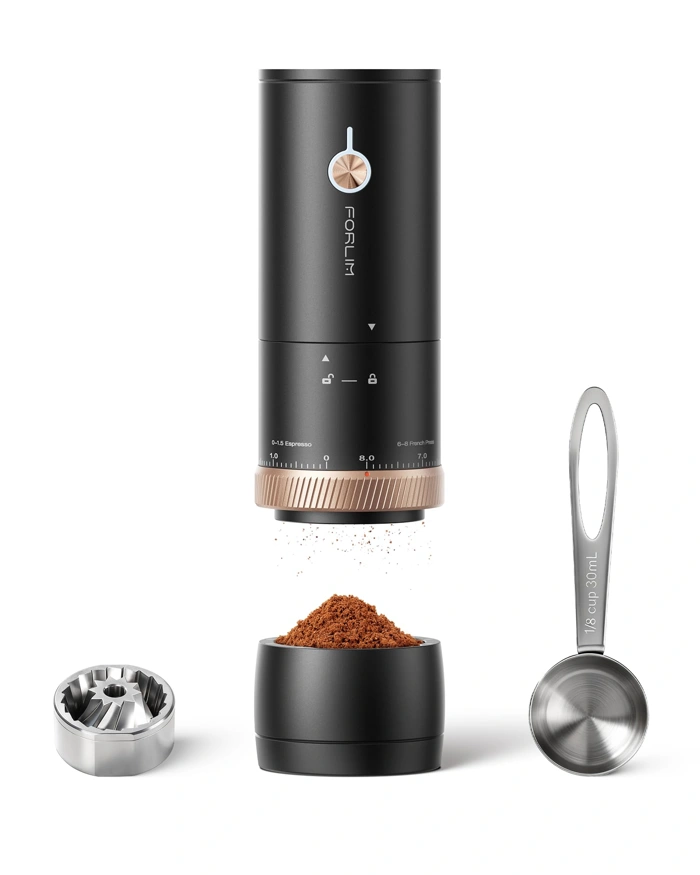
FORLIM Portable Cordless Rechargeable Electric Coffee Grinder
The FORLIM Portable Cordless Rechargeable Electric Coffee Grinder takes a different approach to integration: rather than combining a grinder with a scale, it pairs grinding with portability. This battery-powered model is designed for travel, camping, or small kitchens where counter space and cord management matter.
At $77.39, it sits in the budget-to-mid range, but the value proposition depends entirely on whether you need cordless operation. If you brew at home with access to power, a corded grinder typically offers more consistent motor performance and reduces the need to monitor battery life. If you travel frequently or want to grind beans at a campsite, office, or Airbnb, the portability becomes the core feature.
Because this grinder does not include a built-in scale, you'll still need a separate scale to dose accurately - especially important for espresso or pour-over. That means the workflow isn't more streamlined than a traditional grinder; it's just more mobile. The compact design does make it easier to pack, but you're trading that convenience for the need to recharge between uses and potentially less grinding power compared to plug-in alternatives.
Battery dependency is the main consideration. If the charge runs out mid-trip or you forget the cable, the grinder becomes unusable until recharged. There's also no information available about grind consistency, burr type, or grind settings, so it's difficult to assess whether this model will meet the needs of someone who cares about precision.
This grinder works best as a secondary, travel-focused tool rather than a primary home grinder. If your main goal is to simplify your countertop workflow with an integrated scale, a corded grinder-scale combo or separate scale will serve you better. If portability is the priority and you're willing to carry a separate scale, the FORLIM offers mobility at a reasonable price.
- ✅ Cordless and rechargeable for travel or outdoor use
- ✅ Compact design saves counter space
- ✅ Priced at $77.39, accessible for occasional or secondary use
- ⚠️ No built-in scale, requires separate dosing tool
- ⚠️ Battery dependency limits reliability during travel
- ⚠️ Grind consistency and burr details not available
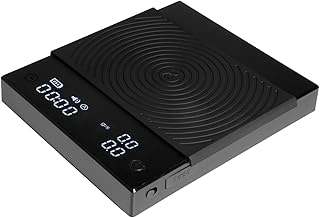
TIMEMORE Coffee Scale Basic 2.0 with Timer and Flow Rate
If you're weighing the tradeoffs of a built-in scale versus modular tools, the TIMEMORE Coffee Scale Basic 2.0 offers a useful comparison. This standalone scale includes a timer and flow-rate indicator - two features that built-in grinder scales often simplify or omit to save cost and space.
At $59.00, the Basic 2.0 gives you precision weighing, start-stop timing, and real-time flow feedback during your pour. Because it's separate from your grinder, you can position it exactly where you need it - under a dripper, next to your grinder, or anywhere in your workflow. If the scale needs recalibration, cleaning, or replacement, you handle that independently without affecting your grinder.
The flow-rate display is particularly useful for pour-over brewing, where pacing matters. Built-in grinder scales typically measure only the dose leaving the grinder; they don't track what's happening during extraction. By keeping your scale separate, you maintain flexibility across different brew methods and preserve the option to upgrade either tool without replacing both.
This modular approach does mean one more item on your counter and an extra step in your routine. But for many users, that tradeoff is worth the added precision, repairability, and control over each part of the process.
- ✅ Includes timer and flow-rate indicator for pour-over precision
- ✅ Standalone design allows flexible placement and independent replacement
- ✅ Works across multiple brew methods, not locked to one grinder
- ⚠️ Requires separate counter space
- ⚠️ Adds an extra step compared to weighing directly in the grinder
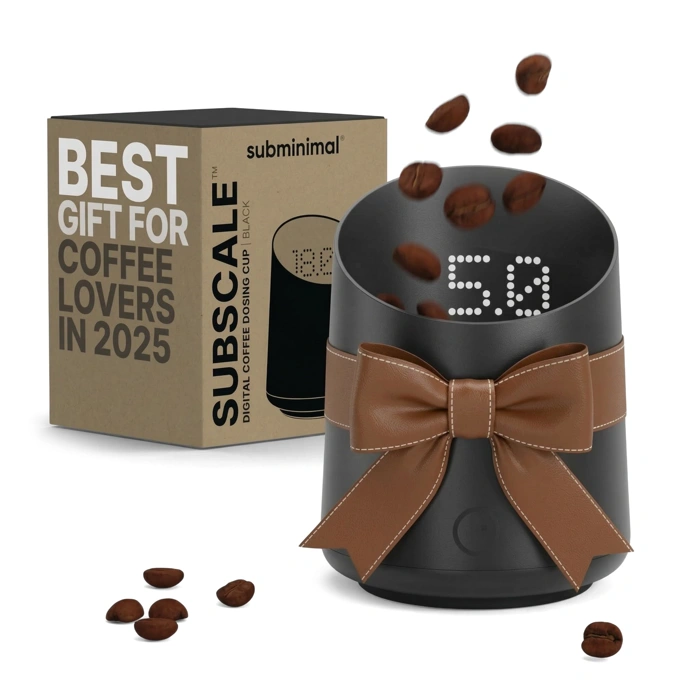
Subminimal Subscale Digital Dosing Cup with LED Display – Sleek & Precise Scale - Dosing & Brewing Accessories, Measures Coffee Grounds for Espresso - Black
The Subminimal Subscale offers a different take on scale integration: rather than embedding a scale inside the grinder, it places precision measurement directly into the dosing cup. This black aluminum cup features an LED display that reads coffee weight in real time as you grind into it, creating a compact workflow particularly suited to espresso preparation.
The design sits neatly on an espresso machine drip tray or countertop, and the cup itself acts as both weighing platform and transfer vessel. Once you've dosed the target weight, you funnel the grounds directly into your portafilter. This approach avoids the mechanical complexity and repairability concerns of integrating a scale into the grinder body - if the scale fails, you replace a $49.95 accessory rather than servicing an expensive grinder.
The form factor works well for single-dosing espresso workflows where you're grinding small amounts frequently. The LED display is easy to read in typical kitchen lighting, and the sleek finish matches modern espresso setups. However, this solution requires an extra step compared to grinding directly into a portafilter, and it adds one more item to clean and store.
Flexibility is a key advantage: the Subscale works with any grinder, so you're not locked into a specific brand or model. If you upgrade your grinder or switch between grinders for different brew methods, the dosing cup travels with you. The tradeoff is that you're managing two separate tools rather than one integrated unit, which may feel less streamlined depending on your counter space and routine.
This integration model suits users who value repairability, want to add precision to an existing grinder without replacing it, or prefer to keep their grinder and scale as independent components. It's less appropriate if you're seeking the fastest possible workflow or minimal counter clutter.
- ✅ Works with any grinder, not tied to a single brand
- ✅ Replaces a $49.95 accessory if scale fails, not an entire grinder
- ✅ Compact form factor fits on espresso machine drip tray
- ✅ LED display easy to read during dosing
- ⚠️ Adds an extra transfer step compared to direct portafilter dosing
- ⚠️ Requires separate cleaning and storage space
- ⚠️ Two-tool workflow may feel less streamlined than true integration
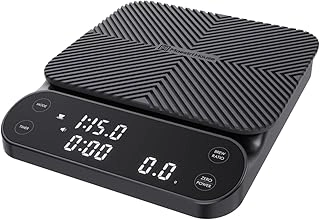
Maestri House S3 Coffee Scale with Timer, 3kg/0.1g Rechargeable Digital Scale, 3 Brew Modes, Adjustable Ratios & Flow Rate Display, Barista-Grade for Pour-Over, Espresso, French Press – Black
The Maestri House S3 offers three brew modes, adjustable ratio presets, and flow-rate monitoring in a single rechargeable scale, making it a flexible choice if you rotate between pour-over, espresso, and French press. The 0.1 g precision and 3 kg capacity cover most home-brewing scenarios, and the built-in timer syncs weight and time on one display.
Because the scale stands alone, you can pair it with any grinder - or upgrade your grinder later without losing your investment in precision weighing. The ratio-adjustment feature lets you dial target brew strength on the fly, and the flow-rate display gives real-time feedback during pour-over without requiring a separate app.
At $39.99, the S3 costs less than the premium tier of integrated grinder-scale combos, yet it remains portable enough to move between your espresso station and a travel bag. The rechargeable battery removes the need for disposable cells, and the silicone pad resists heat and water splashes common in active brewing setups.
Trade-offs include a smaller footprint that may feel cramped under a wide pour-over dripper, and the multi-mode interface requires a brief learning curve to navigate the three brew presets. If you value method flexibility and future-proof modularity over the single-step convenience of an all-in-one grinder, the Maestri House S3 delivers the measurement tools you need without locking you into a specific grinding mechanism.
- ✅ Three brew modes with adjustable ratio presets
- ✅ Flow-rate display for real-time pour feedback
- ✅ Works with any grinder - upgrade path stays open
- ✅ Rechargeable battery, no disposable cells
- ✅ 0.1 g precision across 3 kg capacity
- ⚠️ Compact footprint may feel tight under large drippers
- ⚠️ Multi-mode interface requires initial setup time