We may earn a commission when you buy through links on this page, at no extra cost to you. How this works.
Stepping up from pre-ground coffee means choosing a grinder, and that decision quickly splits into two paths: a manual hand grinder that costs less but demands work, or an entry-level electric burr grinder that automates the task but stretches your budget. Both deliver far better grind consistency than blade grinders, but the tradeoff between effort and convenience is real.
Manual grinders appeal to travelers, small-space dwellers, and anyone keeping initial costs low. They're quiet, portable, and capable of excellent grind quality when well-made. The catch is simple: you turn the crank for every cup, and a full pourover dose can take a couple of minutes of steady grinding.
Electric burr grinders remove that effort entirely. Press a button, walk away, and your dose is ready in seconds. The downside is cost - entry-level electric models typically start where manual grinders top out - and they occupy counter space, generate noise, and depend on power.
This guide compares grind quality, daily convenience, cost, and durability across both types so you can match the tool to your routine. If you brew one careful cup each morning and value portability, a manual grinder may fit. If you make multiple drinks daily or share a household, electric convenience often justifies the price. Understanding what each type does well - and where each compromises - makes the choice straightforward.
Use the matching tool first
Start with Coffee Brew Ratio Calculator if you want to narrow the fit before checking current offers.
Who Should Buy a Manual Grinder?
- You're on a tight budget and want the best grind quality under $30
- You make one or two cups of coffee per day and don't mind the extra time
- You travel frequently or need a grinder for camping, office, or small kitchens
- You value portability and silent operation over speed
- You're patient and enjoy a slower, more hands-on coffee routine
Who Should Buy an Electric Grinder?
- You grind coffee for multiple people or brew several cups daily
- You need speed and convenience in your morning routine
- You have counter space and a power outlet near your brewing area
- You're willing to pay more upfront for long-term time savings
- Noise isn't a dealbreaker in your household
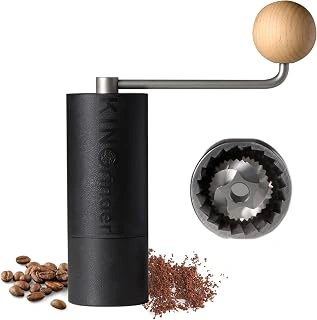
KINGrinder P0 Lightweight Manual Coffee Grinder with ABS Body and Stainless Burr
The KINGrinder P0 brings adjustable conical burr grinding to the budget end of the manual spectrum at $29. Its lightweight ABS body makes it easy to carry in a bag or pack for camping, office, or travel, and the stainless steel conical burr delivers consistent particle size across a wide range of settings - from fine for espresso-style brews to coarse for French press.
Because you control the crank speed and pressure, grind uniformity stays predictable once you dial in your preferred setting. The stepped adjustment ring locks securely, so your grind size won't drift between sessions. Capacity is modest - enough for one or two cups per load - which keeps the effort reasonable but means larger batches require multiple rounds of cranking.
Portability is where this grinder shines. The compact footprint and sub-pound weight let you brew quality coffee anywhere without hunting for an outlet or worrying about motor noise. Setup and cleaning are straightforward: the burr assembly disassembles with minimal fuss, and a quick brush removes residual grounds.
This grinder suits budget-conscious beginners who want to explore grind consistency without a three-figure investment, patient users who don't mind a few minutes of hand-cranking each morning, and travelers who prioritize pack space and battery independence. If you brew solo or in pairs and value grind quality over speed, the P0 offers a low-cost entry point with a 4.8/5 rating that reflects reliable everyday performance.
Speed-sensitive users or households grinding for multiple people back-to-back will find the manual effort adds up quickly. In those cases, an entry-level electric burr grinder trades the $29 price and portability for push-button convenience.
- ✅ Lightweight ABS body ideal for travel and portability
- ✅ Stainless steel conical burr delivers consistent grind quality
- ✅ Adjustable settings span espresso to French press
- ✅ Budget-friendly $29 price point
- ✅ Quiet operation with no motor noise
- ⚠️ Manual cranking requires time and effort for each batch
- ⚠️ Modest capacity means multiple rounds for larger servings
- ⚠️ Not practical for high-volume or multi-person brewing
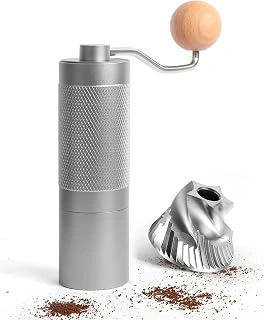
Pro Portable Manual Coffee Grinder with Adjustable Stainless Steel Conical Burr
The Pro Portable Manual Coffee Grinder sells for $29.98 and uses an adjustable stainless steel conical burr, making it the most affordable all-metal burr option in this comparison. It holds a 4.8/5 rating and emphasizes portability and rugged construction, positioning it as a travel-focused alternative to the KINGrinder P0.
Where the KINGrinder P0 uses ceramic burrs and offers multiple-micron adjustment increments, this grinder relies on stainless steel burrs with click-stop settings. Stainless steel burrs resist chipping and handle occasional accidental contact with foreign objects better than ceramic, which matters if you pack the grinder in a backpack or use it outdoors. The tradeoff is that stainless steel can retain heat slightly more during extended grinding sessions, though this rarely affects flavor in manual grinders where session length stays short.
The compact body and lower price make this grinder practical for camping, office drawers, or as a backup unit. Grind consistency will depend on burr tolerances and alignment, but the adjustable conical burr design supports a range from espresso to French press. If you prioritize portability, prefer all-metal burr construction, or want to minimize upfront cost without sacrificing burr quality, this grinder fits better than heavier or more expensive manual models.
Choose the KINGrinder P0 if you grind at home daily and want finer adjustment control. Choose the Pro Portable if you travel frequently, need a durable grinder that survives rough handling, or prefer stainless steel burrs over ceramic for peace of mind during transport.
- ✅ All-metal stainless steel conical burr resists chipping
- ✅ Portable design fits backpacks and travel kits
- ✅ $29.98 price point is the lowest among all-metal burr grinders in this guide
- ✅ Adjustable grind settings cover espresso to French press
- ⚠️ Burr adjustment may offer fewer increments than premium manual models
- ⚠️ Stainless steel burrs can retain slightly more heat than ceramic during extended use
What Is a Manual Hand Grinder?
A manual hand grinder uses a hand crank to turn a conical or flat burr set that crushes coffee beans into grounds. You load whole beans into a hopper at the top, adjust a dial or knob to select grind size - from fine espresso to coarse French press - and rotate the handle until grinding is complete. The grounds collect in a chamber below, ready for brewing.
Manual grinders cost significantly less than electric models, often between $20 and $100 for a decent burr grinder. They weigh only a few ounces and fit easily into a travel bag or backpack, making them popular for camping and office use. Because they rely on hand power rather than a motor, they produce almost no noise and require no electricity or batteries.
The conical burr mechanism in most hand grinders delivers surprisingly uniform particle size, especially in the coarser range. This consistency helps extract balanced flavor from your coffee, and many models rival the grind quality of electric grinders costing two or three times as much. Adjustment is simple: turn a numbered ring or screw to move the burrs closer together for espresso or farther apart for pour-over and French press.
The tradeoff is effort and time. Grinding enough beans for a single cup takes one to two minutes of steady cranking, and a full batch for a four-cup French press can require five minutes or more. Arm fatigue builds quickly with harder, light-roasted beans, and achieving a truly fine, espresso-grade grind demands patience and consistent pressure. Manual grinders work well when you brew one or two cups at a time and don't mind the extra few minutes, but they slow down morning routines when you need to grind for multiple servings.
What Is an Entry-Level Electric Burr Grinder?
An entry-level electric burr grinder uses a motor to spin one burr against a stationary burr, grinding coffee beans with the push of a button or turn of a dial. Most models feature a bean hopper on top, adjustable grind settings, and a catch container below. You select your grind size, press start, and the grinder does the work in seconds.
The main advantage is speed and convenience. Electric burr grinders deliver consistent particle size without manual effort, making them ideal for early mornings or when you brew multiple cups. Operation is quiet enough for most kitchens, though the motor does produce noticeable noise during grinding. Setup is straightforward: fill the hopper, choose your setting, and let the machine run.
Trade-offs include cost, counter footprint, and power requirements. Entry-level electric models start around two to three times the price of a manual grinder, and they need dedicated counter space plus access to an outlet. Maintenance involves periodic burr cleaning and occasional descaling if static buildup attracts fine particles. These grinders are larger and less portable than hand models, so storage can be a factor in smaller kitchens.
Electric burr grinders suit users who prioritize workflow efficiency and grind multiple servings daily. If counter space and budget allow, the time saved each morning adds up quickly compared to manual grinding.
Head-to-Head: Grind Quality vs. Cost vs. Convenience
Manual and electric burr grinders both deliver consistent particle size, but they differ sharply on cost, speed, and effort. A quality manual grinder typically runs $30 to $80, while entry-level electric burr models start around $100 and climb past $200. If you grind 20 grams for a single cup, a hand grinder takes two to three minutes of steady cranking; an electric burr grinder finishes the same dose in fifteen to thirty seconds with no physical effort.
Grind quality sits closer than many assume. Both use conical or flat burrs that crush beans uniformly, so you get even extraction whether you turn a handle or press a button. Electric grinders often include stepless or micro-step adjustment dials, making it easier to dial in espresso or move between brew methods without guessing. Manual grinders use numbered clicks or a threaded collar; they work well for most methods, though fine-tuning espresso can require more patience.
Convenience favors the electric grinder when you make multiple cups each morning or brew for a household. You dose beans, press start, and walk away. Manual grinders shine in quiet environments, travel bags, and small kitchens where counter space and noise matter. They need no outlet and produce almost no sound beyond the crunch of beans. Cost favors the hand grinder by a wide margin at the entry level, letting you put the savings toward better beans or a scale.
Prioritize cost and portability if you brew one or two cups a day and don't mind the ritual. Choose electric if you value speed, serve a crowd, or grind frequently enough that arm fatigue becomes a real friction point.
What About Grind Consistency?
Both manual and entry-level electric burr grinders produce consistent, even grinds suitable for drip coffee, pour-over, and French press brewing. The burr mechanism in each type crushes beans between two abrasive surfaces rather than chopping them, which keeps particle size uniform regardless of whether you turn the handle yourself or let a motor do the work.
Manual grinders at this price point typically use ceramic or stainless steel conical burrs that create even grounds with minimal fines. Entry-level electric models feature similar burr materials and designs, delivering the same grind uniformity. The consistency between the two is comparable when both are properly adjusted and maintained.
Where they differ is speed and physical effort. A manual grinder requires 60 to 90 seconds of steady cranking for a typical single-serve dose, while an electric model grinds the same amount in 10 to 20 seconds with no effort. The grind quality remains similar, but the convenience factor shifts dramatically.
If you already brew methods that demand precision - like pour-over or AeroPress - either grinder type will meet your needs. The choice comes down to whether you value the quiet, portable nature of a hand grinder or the time-saving automation of an electric model.
Cost Breakdown: Upfront vs. Long-Term Value
Manual hand grinders typically start under $30 for basic models and top out around $150 for premium options with ceramic or stainless steel conical burrs. Entry-level electric burr grinders begin around $100 and stretch to $200 for models with more grind settings and build quality. That upfront price gap matters if you're working with a tight budget or unsure how much you'll use a dedicated grinder.
Manual grinders cost nothing to operate and contain fewer mechanical parts that can wear out or break. No motor means no risk of thermal burnout, and most repairs involve replacing a burr set or adjustment mechanism years down the road. Electric grinders draw minimal power - usually under 150 watts - so the annual electricity cost stays negligible, but motors and circuit boards can fail, and replacement parts or repairs often cost $40 to $80.
The real value calculation hinges on frequency. If you grind 12-20 grams once a day, a manual grinder delivers excellent consistency for pennies per use over its lifespan. Grinding that same amount takes 60 to 90 seconds of steady effort, versus 10 to 15 seconds with an electric. For a household brewing multiple cups daily or entertaining guests, those saved minutes add up quickly, and the higher upfront cost spreads across hundreds of uses per year.
Manual grinders make sense when portability, quiet operation, or a lower entry price takes priority. Electric models justify their cost when speed and ease of use matter more than the initial investment, especially for anyone brewing back-to-back batches or switching grind settings frequently throughout the week.
Which Grinder Is Right for You?
Your choice between a manual hand grinder and an entry-level electric burr grinder comes down to how you prioritize budget, daily routine, and effort. Both deliver consistent particle size and better extraction than blade grinders or pre-ground coffee, so either option will improve your cup.
Choose a manual grinder if you value upfront savings, portability, and control over the grinding process. Manual grinders work well for single-cup pour-over, travel, or any situation where you brew one or two cups at a time and don't mind spending a minute or two cranking. They're quiet, compact, and don't tie you to an outlet. The tradeoff is the physical effort required, especially for coarser grinds or larger batches, and the slower pace when you're brewing for multiple people.
An entry-level electric burr grinder makes sense if you brew several cups daily, share coffee with others, or simply want to save time in the morning. The convenience of pressing a button and walking away is hard to overstate when you're juggling breakfast or getting ready for work. You'll pay more upfront and give up some counter or storage space, but the speed and ease can justify the investment if grinding becomes a daily habit.
Neither grinder type is inherently better for grind quality at the entry level - both can produce uniform grounds suitable for most brewing methods. The real deciding factors are cost, how much coffee you make at once, and whether you prefer a slower, hands-on process or a faster, automated routine. If your budget allows and you brew frequently, the electric will feel like a worthwhile upgrade. If you're cost-conscious, brew small amounts, or want something you can take anywhere, the manual grinder delivers excellent results without the added expense.