We may earn a commission when you buy through links on this page, at no extra cost to you. How this works.
Most home latte foam falls flat - literally. Cheap handheld whisk frothers produce airy bubbles that pop before your first sip, while manual steam wands demand timing and coordination that sends milk scalding across the counter. The choice between electric milk frothers and manual steam wands isn't just about price; it's about whether you're willing to trade a learning curve for the texture control baristas rely on, or whether you'd rather press a button and walk away with consistent results every morning.
Manual wands - the kind that attach to espresso machines or operate as standalone steam units - heat milk with pressurized steam while you move the pitcher to create vortex flow. Done right, they produce tight microfoam with a glossy finish. Done wrong, you get scorched milk or a pitcher of hot liquid with no structure. Electric frothers automate the process with spinning discs or induction heating, delivering foam in two minutes without you holding anything. The tradeoff: most electric models can't match the dense, paint-like texture manual wands achieve, though some higher-end electrics come close.
Safety enters the equation when steam wands reach temperatures above 150°F and pressurized systems risk steam burns on hands or countertops. Electric frothers stay enclosed during operation, with auto-shutoff preventing overheating. Convenience skews electric - no purging steam, no pitcher angles to learn, no cleanup of milk residue inside a wand tip. Cost spans both ends: basic manual wands start around $30 as espresso machine attachments, while standalone steam units and premium electric frothers both land in the $80 - $150 range.
This comparison walks through foam quality, day-to-day safety, learning effort, and real-world cost using two distinct approaches. You'll see where each type wins, where each fails, and which suits your morning routine without the guesswork.
Use the matching tool first
Start with Coffee Brew Ratio Calculator if you want to narrow the fit before checking current offers.
What Defines 'Good' Latte Foam for Home Baristas?
Good latte foam starts with microfoam - a velvety texture created by tiny, uniform bubbles that blend smoothly into steamed milk. The surface should look glossy and wet, almost like melted marshmallow, and when you tilt the pitcher the milk should pour in a consistent stream without separating into liquid and foam layers. This pourable consistency makes latte art possible and creates a silky mouthfeel in every sip.
Bad foam announces itself immediately: stiff peaks that sit on top of the milk like whipped cream, large bubbles that pop and leave craters, or a dry, chunky texture that won't pour. You'll often see the milk separate in the pitcher, with a thin layer of foam floating above watery liquid. This happens when air gets incorporated too quickly or unevenly, whether from poor technique with a manual wand or incorrect settings on an electric frother.
The difference matters because microfoam integrates sweetness and body into your drink, while coarse foam just adds airy volume that dissolves fast. Both electric frothers and manual steam wands can produce true microfoam, but they use different methods to stretch and texture the milk. Understanding this standard helps you evaluate which tool will fit your skill level and how much control you want over the final result.
How Manual Frother Wands Work: Pros and Cons
Manual frother wands use a small battery-powered motor to spin a coiled whisk at high speed, incorporating air into milk as you move the wand up and down through the liquid. The technique is simple: submerge the whisk just below the surface, switch on, and guide it in a circular motion to create foam.
These handheld tools cost very little - often under ten dollars - and fit in a drawer or travel bag. Cleanup takes seconds under running water, and the quiet motor won't wake anyone in the next room. Because they're compact and cordless, you can froth directly in your mug or any small pitcher.
The tradeoff is consistency. Achieving velvety microfoam with a manual wand requires steady hand control and practice. If you pulse too fast or pull the whisk out too far, you'll get large bubbles and splatter across the counter. The wand also can't heat milk, so you'll need a separate step on the stove or in the microwave, making it harder to dial in the ideal texture at the right temperature. Frothing a full pitcher takes longer than automatic methods, and holding the wand steady for thirty seconds or more can tire your wrist.
Manual wands work well for occasional lattes or when counter space and budget are tight, but they demand more technique and patience than electric frothers to produce café-quality foam reliably.
How Electric Milk Frothers Work: Pros and Cons
Electric milk frothers automate the entire process by combining a heating element with a motorized whisk inside a closed, insulated chamber. You pour cold milk into the pitcher, press a button, and the machine simultaneously heats and aerates the liquid until it reaches the programmed temperature and texture. Most models offer separate settings for hot foam, hot milk without foam, and cold foam, giving you flexibility for different drinks.
The main advantage is consistency. Because the machine controls both heat and agitation speed, you get repeatable results without needing to monitor steam pressure or wand angle. The closed design also eliminates splatter - milk stays inside the pitcher, which keeps your countertop clean and reduces the risk of burns from escaping steam. Many electric frothers include automatic shut-off and non-stick coatings that make cleanup faster than scrubbing a steam wand tip.
Temperature control is another benefit. Built-in sensors prevent milk from boiling or scorching, a common problem when beginners overheat milk with a manual wand. You can walk away during the frothing cycle, which matters during busy mornings or when you're preparing multiple drinks.
The tradeoffs start with price and size. Electric frothers typically cost between forty and one hundred twenty dollars, compared to fifteen to thirty dollars for a handheld manual wand. They also occupy permanent counter or cabinet space, and the pitcher, whisk attachments, and base add up to more components that need washing after each use. If you choose the wrong heat setting or run a cycle twice, some models will overheat the milk and create large, soapy bubbles instead of dense microfoam.
Electric frothers work well when you want predictable foam without learning curve, but they sacrifice the fine control and compact footprint that manual options provide.
Head-to-Head Comparison: Foam Quality and Consistency
Foam texture and consistency differ significantly between the two tools, though neither holds an automatic advantage across every situation.
Manual steam wands, when used with proper technique, produce dense microfoam with very fine bubbles that integrate smoothly into espresso. This texture is valued by baristas because it supports detailed latte art and delivers a silky mouthfeel. The outcome depends heavily on milk temperature control, wand positioning, and the user's ability to create a rolling vortex that breaks down larger bubbles. Whole milk generally steams more predictably than plant-based alternatives, which can separate or produce uneven foam if the wand angle or steam pressure isn't adjusted. Skim milk froths quickly but lacks the sweetness and body that fat provides.
Electric frothers deliver more uniform results with less practice, making them accessible for everyday home use. Most models whisk milk into stable foam within sixty to ninety seconds, and the consistency remains similar from cup to cup. However, many budget and mid-range frothers generate larger bubbles than a well-operated steam wand, resulting in foam that looks dense but feels coarser on the tongue. Some electric models also heat milk beyond the ideal range, which can scorch proteins and dull the natural sweetness. Higher-end electric frothers with slower whisking speeds and temperature sensors come closer to replicating microfoam, but they still lack the fine control a manual wand offers for adjusting texture mid-stream.
Consistency also shifts with repetition. A manual wand operated by someone still learning will produce uneven foam - sometimes too airy, other times flat - while an electric frother will churn out nearly identical results each time, even if those results are not as refined. For users who value repeatable convenience over the potential for barista-level texture, electric frothers meet that need. For those willing to practice and refine their steaming motion, manual wands open the door to foam that integrates seamlessly with espresso and holds intricate patterns.
Neither tool guarantees superior foam on its own; the deciding factors are the quality of the specific model, the type of milk used, and the skill or patience of the person operating it.
Factoring in Speed, Convenience, and Cleanup
Manual wands require 30 to 60 seconds of active frothing while you hold the pitcher, then rinse clean under the tap in seconds. Electric frothers run unattended for two to three minutes, which frees you to grind beans or prep espresso, but afterward you need to disassemble the pitcher, lid, and whisk attachment for washing. If you count total time - frothing plus cleanup - a manual wand often finishes faster, especially for a single drink.
Electric models suit kitchens where you want to step away during the froth cycle or make multiple servings back-to-back without holding anything. Manual wands shine when speed matters and you prefer immediate feedback on texture. Neither approach demands much effort, but the workflow differs: electric frothers push cleanup to the end, while manual wands fold rinse time into the same minute you finish frothing.
Consider your morning routine. If you multitask - toasting bread, checking email - the unattended cycle of an electric frother pays off. If you value one-and-done simplicity with no disassembly, a manual wand keeps the counter clear and the sink empty faster.
Safety Analysis: Which Frother is Safer for Daily Use?
Manual wands present minimal burn risk because you heat milk separately in a microwave or on the stovetop before frothing. The wand itself stays cool, and your main concerns are splatter from too-deep immersion and hand fatigue during extended frothing sessions. Gripping the wand at an awkward angle for thirty seconds or more can strain your wrist, especially if you're making multiple drinks.
Electric frothers introduce heat directly inside a sealed chamber, which means hot internal surfaces and steam vents that can cause burns if you open the lid too soon or accidentally tip the unit while it's running. Most models include automatic shut-off and cool-touch exterior handles, but the jug interior and any steam release points remain hot for a minute or two after the cycle ends. If you have young children in the kitchen, an electric frother requires the same caution you'd use with a kettle or coffee maker.
Rechargeable manual wands eliminate the battery-compartment concern found in older battery-powered models, where moisture could seep into the handle. Sealed rechargeable designs are easier to rinse without worrying about water intrusion. Both frother types are safe for daily use when you follow basic precautions: let electric jugs cool before opening, keep cords away from water, and hold manual wands steady to avoid hot-milk spray. The key difference is that electric models concentrate heat in one appliance, while manual wands keep the heating step separate and under your direct control.
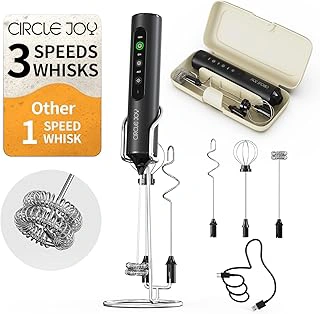
CIRCLE JOY Rechargeable Handheld Milk Frother Wand with Stand, 3 Speeds & 3 Whisks, Black
Manual wand users who want more control without spending much should look at the CIRCLE JOY rechargeable handheld frother. Three speed settings let you start slow to draw air into cold milk, then ramp up to fold the bubbles into microfoam - a level of adjustment most single-speed wands skip. The kit includes three whisks: a standard coil for everyday lattes, a spring tip for denser foam, and a paddle for mixing powders or matcha.
Because it runs on a built-in rechargeable battery, you never hunt for AAAs mid-morning, and the included stand keeps the wand upright on the counter instead of rolling into the sink. At $19.98 with a 4.6 out of 5 rating, it offers strong value for anyone willing to practice pitcher angles and timing. Speed two usually works well for whole milk; speed three helps skim or oat milk catch enough air before the texture breaks.
The trade-off remains technique: you still move the wand, judge depth, and stop before large bubbles form. If you prefer push-button consistency, an automatic pitcher will be easier. But for portability, low cost, and the satisfaction of learning to steam by hand, this three-speed design removes one of the biggest frustrations - a motor that spins too fast or too slow to match your milk type.
- ✅ Three speed settings to match milk type and foam density
- ✅ Rechargeable battery eliminates disposable cell hunt
- ✅ Three whisk attachments for foam, mixing, and matcha
- ✅ Included stand keeps wand tidy on the counter
- ✅ $19.98 price point with 4.6/5 rating
- ⚠️ Requires manual pitcher movement and timing practice
- ⚠️ No temperature control - must heat milk separately
- ⚠️ Foam consistency depends on user skill, not automation
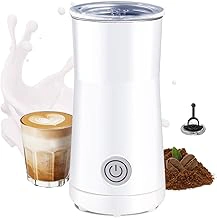
Huogary 2-in-1 Milk Frother and Steamer for Hot Milk, White Medium
The Huogary 2-in-1 heats and froths milk in one automatic cycle, removing the guesswork for anyone who wants consistent foam without standing at the counter. The appliance warms milk to drinking temperature while aerating it, so lattes and cappuccinos come out ready to pour. A single button starts the process, and the machine stops when the cycle finishes.
Foam texture stays uniform batch to batch because the heating element and whisk work at preset speeds. That predictability suits mornings when you need reliable results without adjusting steam pressure or wand angles. The white medium-size housing fits most kitchen counters, and the detachable pitcher simplifies pouring.
Cleanup requires rinsing the interior pitcher and whisk after each use; dried milk film clings to both surfaces if left too long. The unit takes more counter space than a handheld frother and needs an outlet nearby. At $21.99 with a 4.2 out of 5 rating, the Huogary balances automation and affordability for users who prioritize hands-free convenience over the manual control a steam wand provides.
- ✅ Heats and froths milk automatically in one cycle
- ✅ Consistent foam texture without manual technique
- ✅ Single-button operation for hands-free use
- ✅ Detachable pitcher for easy pouring
- ⚠️ Requires rinsing pitcher and whisk after every use
- ⚠️ Takes more counter space than handheld frothers
- ⚠️ Needs nearby outlet
Cost vs. Value: Price and Long-Term Investment
Manual frothers typically sell for around $20, while electric models start near $22 - a difference that feels negligible at checkout but matters when you consider longevity and replacement cycles.
Manual wands are mechanically simple. A stainless-steel screen attached to a shaft and handle contains no motors, no heating elements, and no electronics. With basic rinsing after each use, a well-built manual frother can last years without performance degradation. The only maintenance is an occasional check that the mesh remains intact and the handle mechanism stays smooth.
Electric frothers rely on small motors, heating coils, and sealed chambers. These components wear over time, especially under daily use. Motors can lose power, heating elements may fail, and the non-stick coating inside many jugs can degrade. If you froth milk twice a day, you may face a replacement or repair within a year or two, depending on build quality.
For heavy users who value speed and hands-off operation, the convenience of an electric frother justifies the risk of earlier replacement. The time saved each morning and the consistent results can offset a higher annual cost per cup. For occasional users - weekend lattes or the rare cappuccino - a manual wand offers better long-term value. You pay once, maintain minimally, and avoid the risk of a motor burnout after light use.
Consider how often you froth, your tolerance for manual effort, and whether you prefer to replace a tool every few years or invest once in a durable option. The cheapest purchase is not always the lowest total cost.
Quick Decision Checklist: Which Frother Fits Your Routine?
- Choose manual wand if you want lowest cost, portability, and fastest cleanup
- Choose manual wand if you're willing to practice technique for consistent foam
- Choose electric frother if you want hands-free operation and multitasking ability
- Choose electric frother if you prioritize automatic temperature control
- Choose manual wand if counter space is limited or you travel often
- Choose electric frother if you make multiple drinks back-to-back daily
Our Verdict: Which Milk Frother is Right for You?
Neither manual wands nor electric frothers earn a universal win - each type serves different priorities. Manual wands cost less, travel easily, and rinse clean in seconds, but they require practice and active attention to produce smooth microfoam. Electric frothers automate the process and deliver consistent results without skill, yet they come with higher price tags and longer cleanup routines involving multiple parts.
If you make lattes occasionally or pack gear for trips, a manual wand offers the flexibility you need without the bulk or investment. Daily coffee drinkers who value hands-free operation and repeatable foam quality will find electric models worth the extra cost and counter space.
Your workflow and budget matter more than any blanket recommendation. Consider how often you froth milk, whether you prefer control or convenience, and how much time you want to spend on cleanup. Match the tool to your real habits rather than chasing a one-size-fits-all solution.